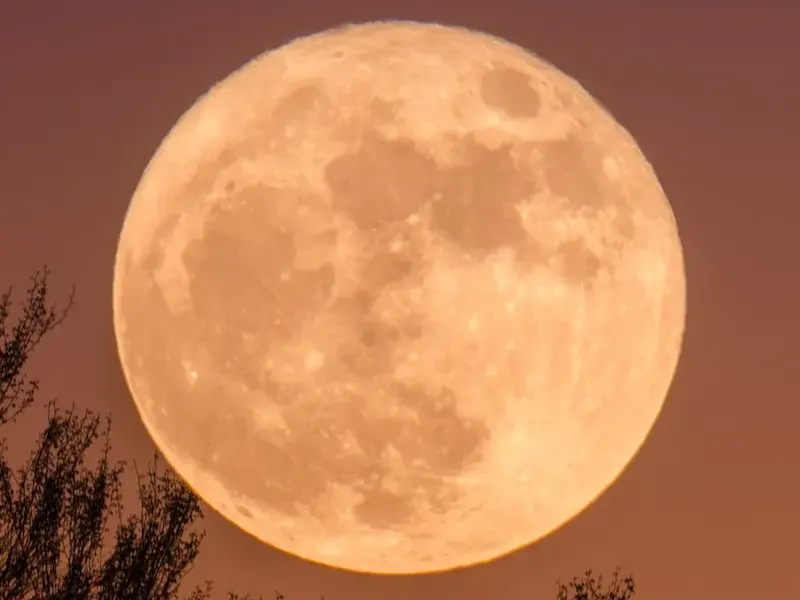

“The flower moon’s name comes from the fact that the full moon coincides with flowers blooming in the spring across North America,” said Catherine Pilachowski, an astronomer at Indiana University. May 2026 promises to be a remarkable month for skywatchers with not just one, but two full moons. The first, known as the Flower Moon, will reach its peak fullness on May 1 at 1:23 p.m. ET.
The Flower Moon is named for the beautiful blooms that adorn gardens and fields during springtime. It will rise in the southeastern sky after sunset on May 1 and remain visible past midnight. As it ascends, observers might catch a glimpse of its orange or red hue due to atmospheric scattering when it’s low on the horizon.
Key facts about the Flower Moon:
- The Flower Moon is part of a month that features two full moons, which occurs every two to three years.
- It is also referred to as the Planting Moon, Milk Moon, Hare Moon, and Budding Moon.
- The illumination of the Flower Moon will be at 99% on both May 1 and May 2.
Later in the month, skywatchers can look forward to a Blue Moon on May 31 at 4:45 a.m. ET. This second full moon of May will be classified as a micromoon, appearing about 6% to 7% smaller than an average full moon because of its distance from Earth.
A Blue Moon is defined as either the second full moon in a calendar month or the third full moon in a season that has four full moons. Pilachowski explained, “A blue moon is a second full moon in any month, or a second full moon in a month of any season that has four full moons.” The upcoming Blue Moon will also present an opportunity for astrophotography enthusiasts to capture stunning images of this celestial event.
What to look for:
- The lunar halo—a ring around the moon—will be visible during both events. This optical effect occurs due to ice crystals in Earth’s upper atmosphere.
- If you’re watching the Flower Moon early on May 1, look for Antares, the brightest star in Scorpius, positioned to its left.
- The distance of the Blue Moon from Earth will be approximately 252,360 miles.