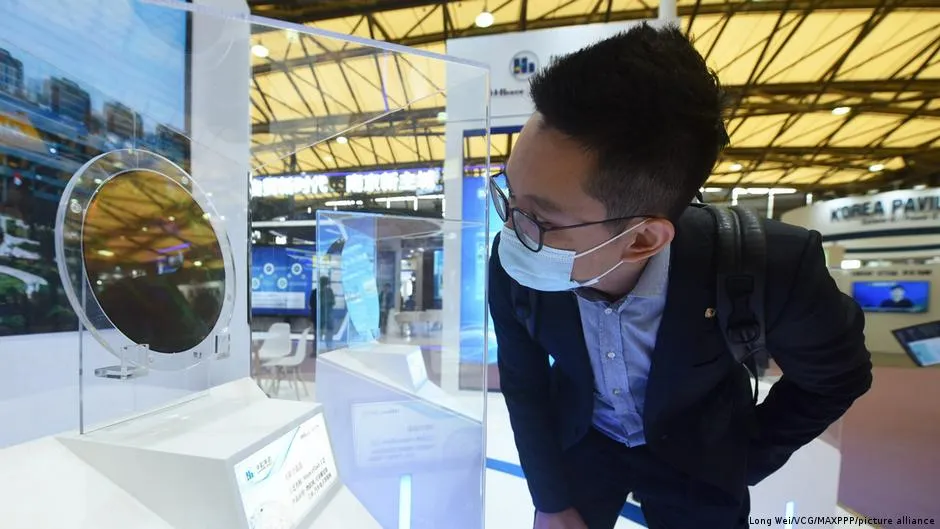

China’s semiconductor industry is rapidly expanding, capturing a 30% share of the global market for legacy chips. This growth comes despite significant technological and geopolitical challenges, particularly in US-China relations.
Chinese firms like SMIC reported record revenues of $9.3 billion last year, reflecting the industry’s robust performance. Meanwhile, HuaHong has been operating at an impressive 106% capacity due to soaring demand for chips.
The push for self-reliance in chip production has intensified as the US imposes export curbs on advanced semiconductors. “Beijing wants to achieve chip self-sufficiency, but the current level is nowhere near it,” said Ryu Yongwook, highlighting the uphill battle ahead.
This expansion aligns with China’s broader strategy outlined in its Made in China 2025 plan, which aims to bolster domestic manufacturing capabilities. In addition to legacy chips, China has successfully produced 7-nanometer-class processors for Huawei smartphones, showcasing advancements in AI technology.
However, experts caution that access to cutting-edge US technology remains crucial. Tim Rühlig noted, “There is only so much that you can do without access to the US’s most advanced chipset.” This limitation could hinder China’s aspirations for technological independence.
Key facts about China’s semiconductor industry:
- SMIC recorded revenues of $9.3 billion last year.
- China holds a 30% share of the global market for legacy chips.
- HuaHong operates at 106% capacity due to high demand.
- The country’s GDP growth has slowed to about 5%, indicating reliance on productivity improvements.
- The working-age population is projected to decline significantly by the end of the century.
The implications of this expansion are significant for both local and global markets. John Lee pointed out that Chinese production increases could drive down chip prices globally and pressure non-Chinese vendors. As China continues to invest heavily in its semiconductor sector, the landscape of chip production may shift dramatically.
This expansion not only affects manufacturers but also has broader consequences for the global economy. As tensions between China and the US persist, how these developments unfold will be closely monitored by industry leaders and policymakers alike.