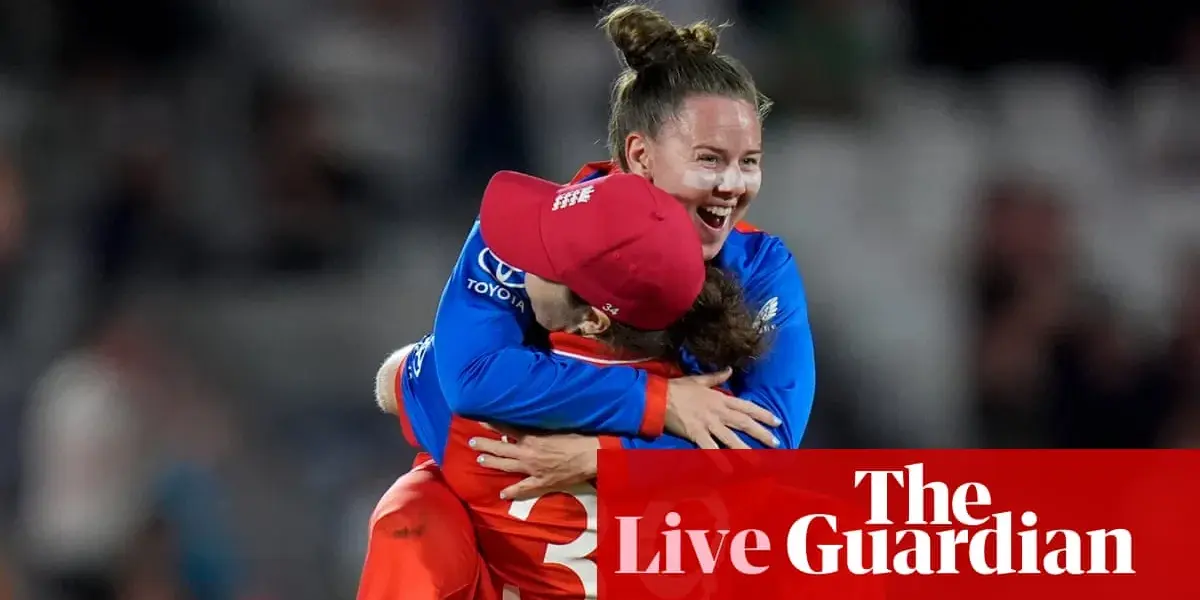

England have advanced to the final of their home T20 World Cup after a significant 40-run victory against South Africa. The win was largely propelled by half-centuries from Nat Sciver-Brunt and Heather Knight, who formed a crucial partnership after an early setback for England.
The semi-final match saw England recover from a challenging position of 23 for 3, with Sciver-Brunt and Knight combining for a 133-run fourth-wicket partnership. This stand, achieved off 90 balls, marked the highest partnership for any wicket in a Women’s T20 World Cup semi-final. Their efforts led England to a total of 169 for 5 in their allotted 20 overs.
Sciver-Brunt, returning to the squad after missing three matches due to a calf injury, scored 75 runs off 47 balls. Knight contributed 58 runs off 47 balls. Following their strong batting performance, England’s bowlers contained South Africa to 129 for 8 in their 20 overs, securing the victory.
England’s innings and key performances
The start of England’s innings was difficult, with early wickets falling to South Africa’s bowlers Shabnim Ismail and Marizanne Kapp. England found themselves in trouble at the end of the powerplay, matching their worst performance in that phase of play during the tournament. Kapp was particularly economical, conceding only one boundary and taking 1 for 16 from her four overs. Ismail finished with figures of 2 for 31.
Among the early dismissals was opener Danni Wyatt-Hodge, who managed 12 runs. Ismail made history by becoming the first woman to achieve 50 wickets in T20 Women’s World Cups when she dismissed England opener Amy Jones with her first ball. Jones has experienced a difficult run with the bat since her half-century against Sri Lanka at the start of the tournament, scoring only 36 runs in her subsequent five innings.
Ismail claimed her second wicket shortly after, dismissing Alice Capsey. Kapp also contributed to the early pressure by bowling Wyatt-Hodge. Despite these early challenges, the partnership between Sciver-Brunt and Knight stabilised the innings. Sciver-Brunt, who hit 11 fours and a six, showed no signs of her recent injury while running between the wickets. Knight reached her fifty with a six off Ayabonga Khaka. Both players were dismissed by Nonkululeko Mlaba within three balls of each other, but not before setting a substantial target.
South Africa’s chase and England’s fielding
In response, South Africa’s chase began with Laura Wolvaardt and Tazmin Brits. Wolvaardt, who had a frustrating tournament, struggled for strike early on but reached 13 runs by the end of the powerplay. However, her innings was cut short by a sharp overhead catch from Sophie Ecclestone off the bowling of Linsey Smith, ending South Africa’s opening stand at 43.
England’s fielding was a notable aspect of their victory, showing significant improvement since their 2024 campaign. Ecclestone made another crucial contribution by taking a difficult catch to dismiss Sune Luus. Knight and Sciver-Brunt also held straightforward catches, including the wicket of Tazmin Brits, who scored a fighting 51 runs. A direct hit from Wyatt-Hodge to run out Sinalo Jafta in the penultimate over further highlighted England’s improved confidence and execution in the field.
The match was played in front of 21,128 people in South London, setting a record for a women’s match at The Oval. England will now face Australia in the final on Sunday at Lord’s.
Source: island.lk